Buying a house in Barcelona is a major investment in which you need to weigh up many factors, such as the price you’re willing to pay, the location you want, the amenities you’d like the area to have, and the total cost of the transaction. In this article, we analyse Barcelona’s residential market, with prices by area and the steps you can follow to buy with confidence.
The state of Barcelona’s residential market
The housing market in Barcelona continues to boom and is characterised by several factors:
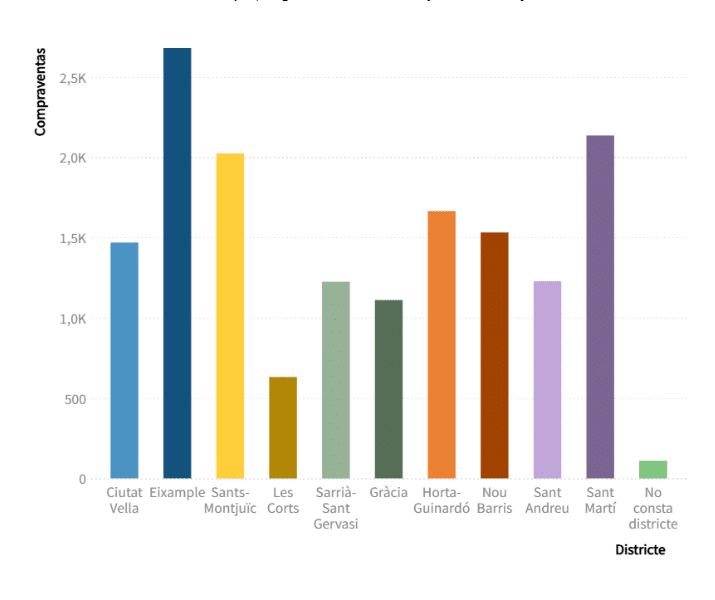
Home sales by district
According to data published by the Barcelona City Council, the district where the most homes are sold is Eixample, followed by Sant Martí and Sants-Montjuïc.
Who buys property in Barcelona
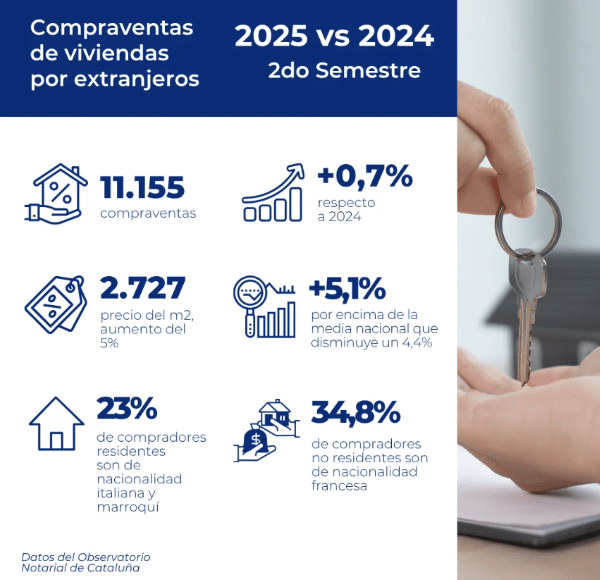
Buyers of homes in Barcelona are both domestic and foreign. According to data from the Notarial College of Catalonia, foreign buyers acquired 1 in every 7 homes sold in Catalonia during the second half of 2025. There was also a 0.7% increase compared to the same half-year period the previous year, putting home purchases by foreigners in Catalonia above the national average.
The French are the foreign nationals who buy the most homes, accounting for 34.8% of transactions, followed by Germans with 10.5% of purchases.
What prices are paid by area
Data from idealista.com shows the following:
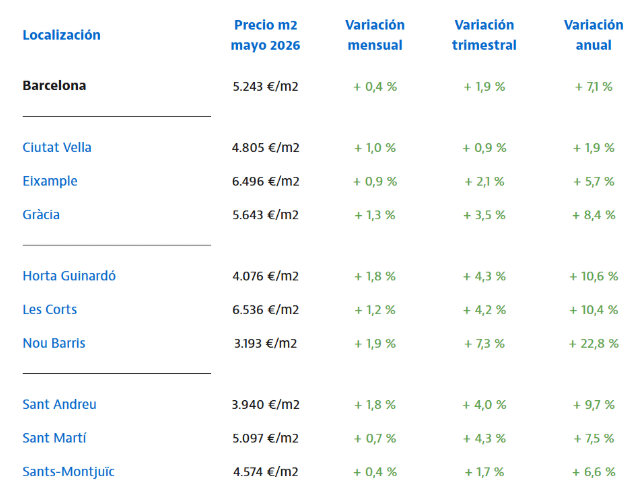
- – The average price per square metre in Barcelona in May 2026 is 5,243 euros.
- – This represents a 0.4% increase compared to April 2026 and a 7.1% increase compared to May 2025.
- – By area, the highest prices per square metre are found in:
- – Sarrià-Sant Gervasi at 7,051 euros per square metre, representing a monthly increase of 0.7% and a quarterly increase of 1.5%.
- – Les Corts at 6,536 euros per square metre, with a monthly change of 1.2% and a quarterly change of 4.2%.
- – Eixample at 6,496 euros per square metre, representing a monthly increase of 0.9% and a quarterly increase of 2.1%.
- – Prices have risen in all neighbourhoods compared to both the previous month and the previous quarter.
Characteristics of Barcelona’s residential market
The housing market in Barcelona has unique features that make it an opportunity for buyers:
- · Demand is both local and international and is constantly evolving.
- · Prices rise every year, especially in prime areas.
- · Various new-build developments are under construction, standing out for their modern design and focus on energy efficiency.
In this context, it’s clear that buyers are increasingly well-informed, with higher expectations regarding sustainability and the quality of what they buy.
How to choose where to live in Barcelona?
It depends on what you need:
- · If you want peace and quiet, even while living in a major city, the upper part of town, with neighbourhoods like Pedralbes or Sarrià-Sant Gervasi, is the perfect spot.
- · Public transport and access. The city is very well connected by public transport, with major hubs such as Plaça Catalunya and Passeig de Gràcia. Access by car is also straightforward, with numerous public car parks and resident parking zones.
- · Amenities near the home also matter: schools, supermarkets, health centres, pharmacies, gyms, restaurants. Here you should think about what you need and check the amenities available in the area where you want to live.
- · The type of property also makes a difference. In the upper part of town, Les Corts and Gràcia, you can find larger homes such as chalets, detached houses or mansions, while other neighbourhoods are dominated by flats, penthouses, lofts or studios.
Steps to safely buy a house in Barcelona
Buying a property in Barcelona involves following a series of steps, which may include the following:
- · Define the home of your dreams. Here you’ll need to set out the main features: location, amenities you need (schools, supermarkets, leisure areas), number of bedrooms, floor level, orientation, finishes, and whether you want a new-build or resale property. You’ll also need to set a realistic budget based on your needs.
- · Visit and choose the property that will become your home. At this stage, it’s advisable to get help from a real estate consultant who specialises in Barcelona, who can do an initial filter of properties matching your criteria so you can visit the ones that genuinely interest you. If there’s a particular property you’re interested in, it’s a good idea to visit it with a technical expert to check for any damage or hidden defects.
- · Handle all the paperwork. To buy safely, you should request the property’s land registry extract (nota simple), which will show the owner, any charges, and the surface area. You can also request the community bylaws to learn about the rules in place, and the certificate confirming there’s no outstanding debt, to verify there are no unpaid community fees. Also request proof of payment for IBI (property tax) receipts for the last four years.
- · Calculate the total cost of the transaction. In a property purchase, you don’t just pay the price; there’s a series of costs and associated taxes you’ll need to factor in:
- · Notary fees. You can ask the notary how much the transaction might cost and negotiate with the seller how this cost, together with the Land Registry fee, will be split.
- · Land Registry fees. You can also check with the Registry how much registering the sale might cost.
- · Property Transfer Tax or VAT. The taxes payable will depend on whether it’s a first transfer (new-build property) or a second transfer (resale property).
- · Conveyancing fees. The conveyancer will handle registering the sale and paying the taxes, so they will charge fees plus a deposit to cover payments to the Registry and the tax authorities.
- · Mortgage-related costs. These can include, for example, the property valuation or the cost of setting up the mortgage.
According to the Catalan Civil Code, costs are distributed as follows:
The costs of delivering the transferred property are borne by the sellers. The costs of executing the deed and issuing the first copy, along with other costs arising after the transfer, are borne by the buyers, unless a special provision or agreement states otherwise.
It’s common for buyer and seller to agree to split these costs 50/50.
- · Apply for financing, if needed. You can negotiate mortgage terms with several banks. It’s essential to look not only at the interest rate but also at the other terms they offer.
- · Sign the deed and register it with the Land Registry. It’s important to carefully read the contents of the deed before signing and to ask the notary if you have any doubts. At the time of signing, the property is handed over and the seller will give you the keys. The final step is registering the sale with the Land Registry, so the property is officially in your name.
As we’ve seen, buying a house in Barcelona takes time and involves weighing up many factors that influence the decision to purchase a home. At Proddigia we are expert real estate advisors in this type of transaction, and we can help you find the property you’re looking for.